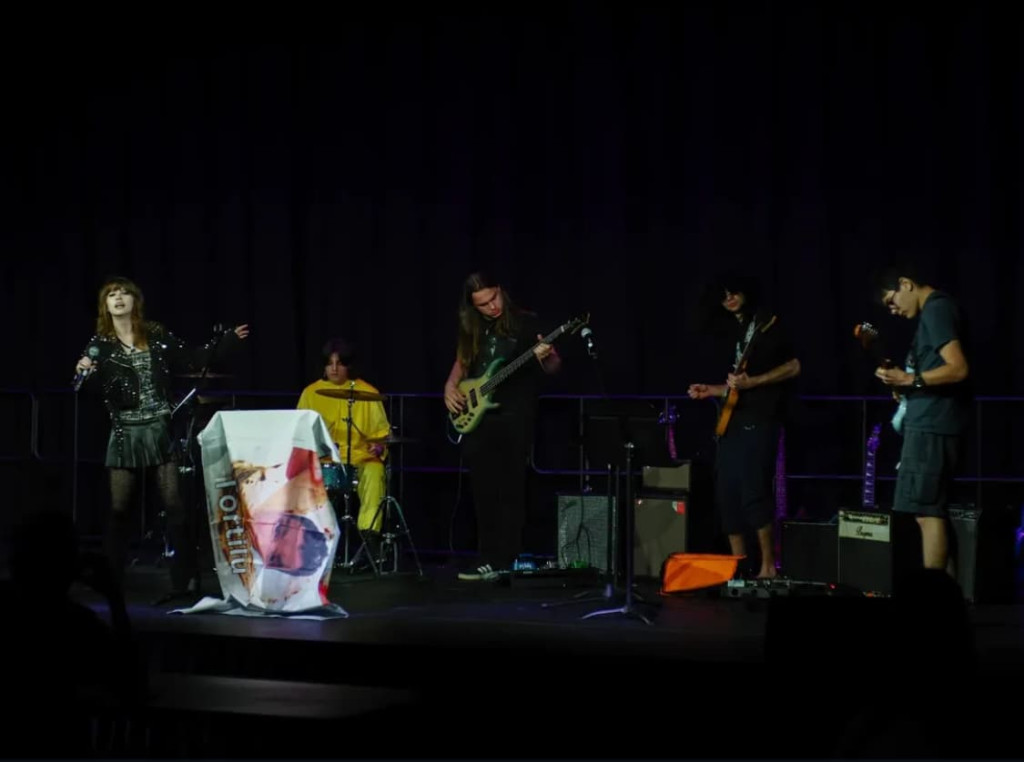
Their story starts where many great ones do: a basement.
Liam’s basement, to be exact. Loud, unpolished, and alive.
At the end of the last school year, Tripstitch came together and spent their summer
vacation doing what most people only talk about — they wrote an entire album. Ten songs,
built from scratch, shaped by long sessions, different personalities, and a willingness to
experiment without overthinking.
“It was always loud as shit,” they say — and that might be the most accurate description of
their process.
A Sound That Refuses to Sit Still
Trying to define Tripstitch’s sound is almost missing the point.
Elijah (rhythm guitar) leans heavily into shoegaze and alternative textures.
Liam (drums) brings in hardcore, metal, and punk energy.
Max (lead guitar) lives somewhere between classic rock and 80’s shred.
Sam (bass) approaches everything with a jazz mindset.
Audrey (vocals) pulls from a wide emotional palette — from The Cranberries to Fiona
Apple to Alice in Chains.
On paper, it shouldn’t work.
In practice, it creates something unpredictable.
Instead of blending into a genre, Tripstitch builds each song around a feeling —
sometimes abstract, sometimes specific, always personal. One track might explore
insanity, another alcoholism. Then suddenly, you're driving in the rain… or imagining an
underwater expressway.
There are no boundaries — and that’s intentional.
“We never want to back ourselves into a corner creatively.”
Influence Without Imitation
Each member carries their own set of influences:
• Sam draws from legends like James Jamerson
• Audrey channels artists like Fiona Apple and The Cranberries
• Max studies technical masters like Randy Rhoads and Steve Vai
• Liam is shaped by drummers like Dave Lombardo and John Bonham
• Elijah looks to guitarists like Kevin Shields and Thurston Moore
But none of it is copied.
Everything gets filtered, distorted, reinterpreted — until it becomes something that feels
uniquely theirs.
The goal isn’t to sound like someone else.
It’s to sound like Tripstitch.
From Riffs to Real Songs
The band’s early songwriting process was simple: Elijah brought riffs, and the rest built
around them.
But even that is evolving.
Now, there’s a conscious shift toward more equal creative input — a move that reflects
their growth not just as musicians, but as a unit.
Audrey’s role stands out in a different way. She often arrives with pages of lyrics — raw
material that gets reshaped and molded into melodies as the music takes form. The result
is a blend of structured emotion and spontaneous creation.
Nothing is forced.
Everything finds its place naturally.
Doing It The Hard Way (Because There Was No Other Way)
Tripstitch didn’t have a big budget.
They didn’t have a studio.
They didn’t even have a permanent recording setup.
So they built one.
Recording drums meant setting everything up — and tearing it all down again.
Mixing meant learning on the fly.
Producing meant trial, error, and figuring it out until it worked.
Their first release, Driving with Square Tires, is more than just music — it’s proof that they
made it happen with what they had.
And that matters.
Small Wins That Mean Everything
From forming the band (which wasn’t easy) to finding time to rehearse, every step forward
has been earned.
One standout moment: playing an original track at their school’s Battle of the Bands,
competing against 12 groups.
Another: hearing their own recorded music come together — not just as noise in a
basement, but as something tangible.
These aren’t headline moments.
But they’re real.
What Comes Next
Tripstitch isn’t standing still.
They’re already working on new music — this time with a sharper ear for composition and
production. Songs like Pain for the Brain and Fragile marked a turning point, where chaos
started to turn into cohesion.
Now, they’re chasing clarity without losing their edge.
They’re also looking outward — hoping to collaborate and play live, especially with local
bands like Catfish. There’s even talk of a crossover idea (“Tripfish”), but for now, it starts
with getting on stage.
Because that’s the missing piece.
No Rules. No Apologies.
If there’s one message Tripstitch stands behind, it’s this:
Ignore the rules.
Not in a careless way — but in a creative one.
Music, art, expression — none of it should be boxed in by expectations.
“Whatever you want to experience through art is entirely personal.”
And that’s exactly what they’re building:
A space where different ideas collide, where imperfections are part of the process, and
where creativity isn’t filtered down — it’s turned up.