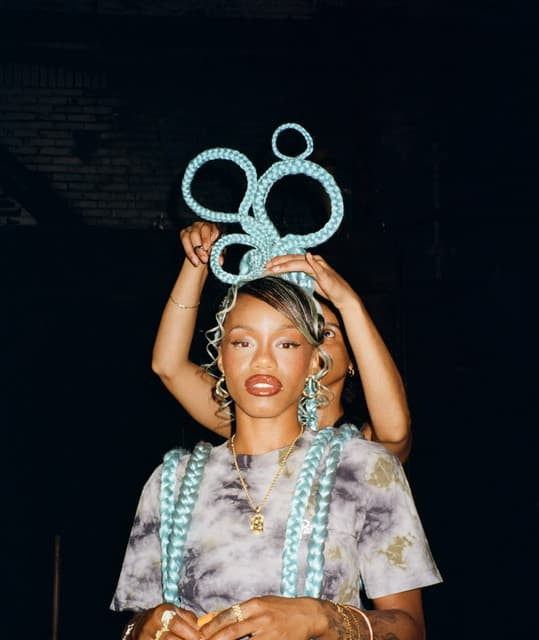
It takes a lot to stop people mid-scroll now. Music moves faster than ever, attention spans are thinner, and every day brings another wave of songs fighting for the same few seconds of curiosity. That is exactly why an artist like SALIMATA stands out. Her music does not ask to sit quietly in the background. It cuts through. It speaks plainly, thinks deeply, and leaves a mark.
The Brooklyn-born rapper, who now moves between New York and Europe while working with Fada Records, is building a body of work rooted in honesty. Across projects like OUCH and Wooden Floors, SALIMATA has developed a voice that holds femininity, rage, humor, reflection, and social commentary all at once. She is not interested in being reduced to one thing, and that refusal is part of what makes her so compelling.
A Voice That Feels Grounded in Truth
SALIMATA’s writing carries the kind of clarity that makes you lean in. There is thought behind the bars, but there is also instinct. Her approach to rap feels less like performance and more like direct communication. That comes through especially in “FOIL,” the track that brought a new level of attention her way after her On The Radar freestyle began circulating online.
What makes that moment even more telling is that she did not expect “FOIL” to be the song people would latch onto. In her mind, it was the more reflective, more pointed record. But the response confirmed something important: listeners are still hungry for substance. SALIMATA proudly identifies with conscious rap, while also making it clear that the label only explains one side of her. She has range, different pockets, and no interest in shrinking herself to fit other people’s expectations.
Refusing the Box
That sense of freedom runs through everything she says about identity and artistry. In a rap landscape that still tries to flatten Black women into digestible categories, SALIMATA’s answer is simple: she stays true to herself. Whatever form the music takes, it still sounds like her. That self-awareness gives her catalog its backbone.
There is also a rare ease in the way she talks about vulnerability. For some artists, revealing too much is a risk. For SALIMATA, it feels natural. She understands that the most personal writing often creates the deepest connection. Rather than pulling back, she leans further into the truth of her experiences, trusting that someone on the other side of the song needs to hear it said out loud. That kind of writing does more than document emotion; it gives people language for their own lives.
Brooklyn, Growth, and the Energy of Return
Coming back to Brooklyn after spending time overseas seems to have sharpened her perspective. SALIMATA speaks about New York as a place that stays familiar while you become someone new inside it. That tension matters. It gives her a stronger view of home, of community, and of the people who understand her without much explanation.
That return also arrives at a moment of visible growth. She describes being grown not as having everything figured out, but as learning how to handle life differently than before. Looking back and recognizing that your reactions have changed, your discipline has changed, your emotional range has changed—that is her measure of progress. It is a grounded outlook, and it mirrors the way her career feels right now: more intentional, more directed, and more certain of its purpose.
Making Music That Gives Black Women Permission
One of the clearest takeaways from SALIMATA’s perspective is who she wants her music to reach and empower. She wants Black women to feel comfortable in themselves, powerful, and unconcerned with outside judgment. Her phrase for it—being a “nice bully”—lands because it captures the duality she is after: kind, but not to be played with. Strong, but still fully yourself.
That balance says a lot about her wider presence as an artist. SALIMATA is thoughtful without sounding distant, sharp without losing warmth, and honest without dressing things up for approval. Even when she talks about health, movement, or the next chapter of her sound, there is a consistent thread: she is learning how to move with more care, more intention, and more confidence in her own instincts.
Conclusion
SALIMATA feels important because she represents something that can get lost in a crowded music landscape: real perspective. Her music is personal, but never closed off. It is reflective, but never static. And most importantly, it sounds like someone who knows that being multidimensional is not a weakness, but the whole point.
At a time when so much music is built for quick consumption, SALIMATA is making work that asks for presence. She is not chasing a box, a trend, or a simple label. She is building her own shape in real time. And from where I’m sitting, that makes her one of the most interesting voices to watch right now.